From P6 to Sec 1: what really changes, and how to help your child through the jump
After PSLE comes a long holiday, then January brings new subjects, new teachers and new routines all at once. Here's what to expect, and the small things that make the biggest difference.
In short
- Sec 1 is mostly harder because there is more of it: more subjects, more reading, more to organise. The work itself is not suddenly much harder.
- A wobbly Term 1 usually means overload, not lack of ability. A clear weekly routine helps more than extra hours.
- Short daily study, a plan you make together each Sunday, and asking your child to explain things back to you all make a real difference.
For most families, PSLE feels like the finish line. Then, a few weeks into Secondary 1, many parents notice something unexpected. A child who coped well in primary school suddenly seems tired, scattered or unsure.
If this happens in your home, you are not alone, and your child is not falling behind. Secondary school changes many things at the same time. Most children need a term or so to find their feet.
What changes in Secondary 1
No single change is huge. It is the number of changes, all arriving in the same few weeks, that wears children out.
- More subjects. Your child may go from four or five subjects to nine or more, each with its own teacher, homework and test dates.
- New subjects, all at once. History, Geography and Literature usually start together, each with new words and new ways of answering.
- Subjects at different levels. Under Full Subject-Based Banding, your child may take some subjects at a different level from others. That is normal and can change over time.
- Longer days. School often ends later, and CCA adds a few afternoons a week. There is less free time to rest and catch up.
- More independence. Teachers expect students to track their own timetable, homework and tests, with fewer reminders than in primary school.
- New friends. Most children are starting again socially. Making friends takes energy too, even when it goes well.
What the first year usually looks like
November and December: the long break
A good time to rest, and to talk about what is coming. Buying books and uniforms together can make it feel real in a gentle way.
January: the busy first weeks
Orientation, a new timetable, CCA trials and lots of new names. Expect tiredness. Early nights matter more than extra study right now.
February to March: the first tests
The first class tests and assignments arrive. Marks may be lower than your child is used to. This is often the moment confidence dips.
Term 2 onwards: finding a rhythm
By now most children have worked out what each teacher wants. Habits built in Term 1 start to pay off here.
Why History can feel like the biggest jump
In primary school, Social Studies is mostly about knowing and describing. Secondary History asks for more. Students have to explain why things happened, back up their answers with evidence, and judge whether a source can be trusted.
This means a child can know all the facts and still lose marks. Here is a simple example of the difference.
Once students see what a question is really asking, most improve quickly. The facts were never the problem. They just needed to see how to use them.
Overload or ability? Signs to watch for
- Reading the same pages again and again, but not remembering them.
- Saying "I studied it, but I blanked in the test."
- Long evenings at the desk with little to show for it.
- Leaving homework until late at night, then rushing.
- Quietly deciding they are "just not good at" a subject.
These usually mean the content is coming in chunks that are too big, or that your child has not yet found a way to study that works for them. They rarely mean a lack of ability. Breaking the work into smaller pieces often helps within a few weeks.
Six things that help
Talk about it before January
Use the holidays to talk about what will be different. Tell your child the first few weeks feel messy for everyone. Knowing that in advance takes a lot of the worry away.
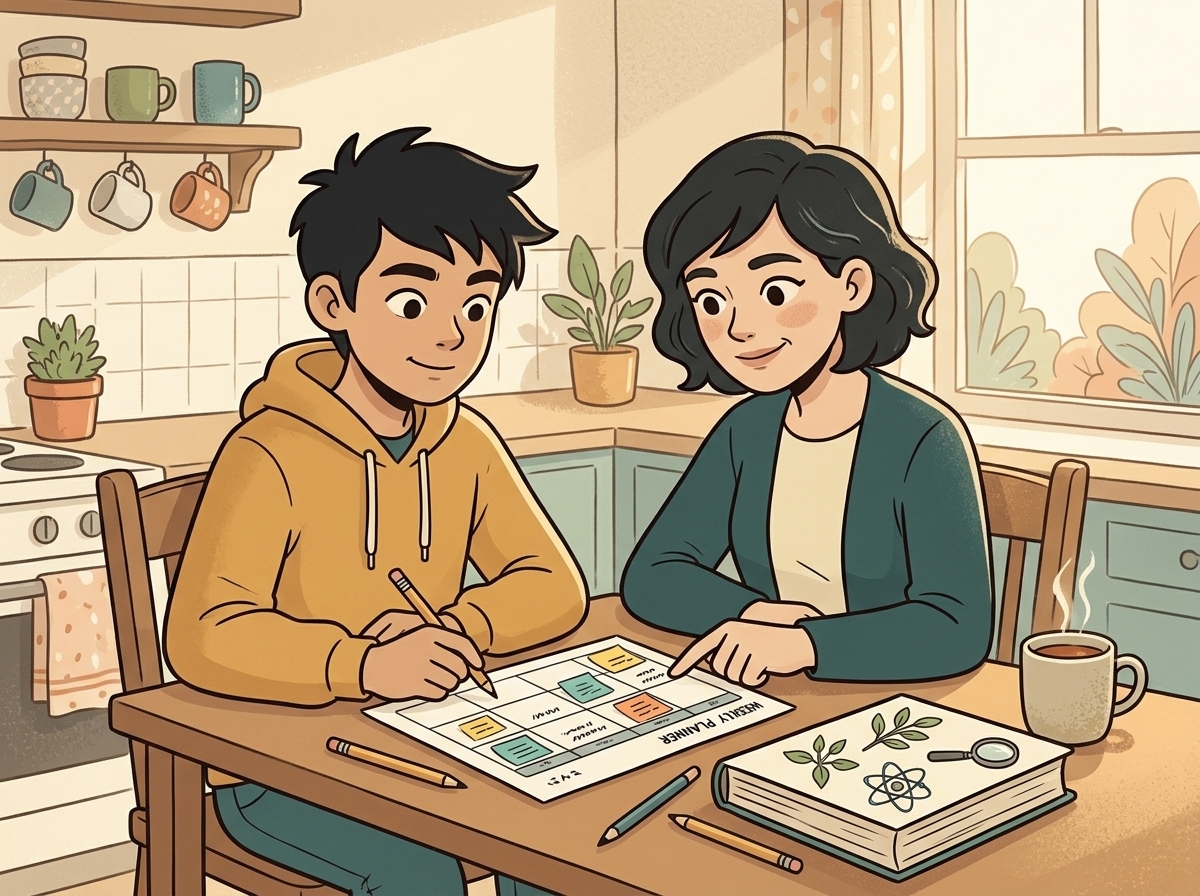
Plan the week together on Sunday
Spend ten minutes putting the week's homework, tests and CCA on one page. Seeing it all at once makes it feel manageable, and it shows which days are busy.
Little and often
Fifteen to twenty focused minutes on most days works better than a three-hour cram before a test. Short sessions are also easier to start, which matters on tired evenings.
Ask them to teach you
Instead of "What did you learn today?", try "Can you explain it to me?" Putting an idea into their own words is one of the best ways to remember it. You do not need to know the answer yourself.
Praise the effort, not just the mark
Term 1 results can wobble. Notice the habits that will pay off later: starting early, asking a teacher for help, having a go at a hard question.
Keep the form teacher in the loop
If something carries on for more than a few weeks, the form teacher is the best person to speak to first. They see your child across the whole school day.
What to say, and what to avoid
- Try: "Which subject felt hardest this week? What part of it?" Small, specific questions are easier to answer than "How was school?"
- Try: "Lots of people find Sec 1 tiring. What would make this week easier?"
- Avoid: comparing with siblings, cousins or friends. Every child settles at a different pace.
- Avoid: treating a low first test as a sign of the whole year. It is one result, early on, while everything is new.
Where Our Study Tribe fits
We built Our Study Tribe for exactly this step, starting with History. Each topic is broken into short videos of about five minutes. The key arguments are laid out clearly underneath, so your child can revise without rereading a whole chapter.
Practice questions show how answers are marked before students write, so they learn what an explaining answer looks like. And students can study with a small group of friends, so they are not doing it alone.