SBQs and PEEL, explained for parents
Your child keeps mentioning SBQs and PEEL paragraphs. Here's what they mean, what History tests are really looking for, and how you can help, even if you never studied History yourself.
In short
- Lower Secondary History tests mostly use two kinds of question: source-based questions (SBQs) and structured essay questions.
- Both reward the same thing: a clear point, backed by evidence and explained. PEEL is a simple way to build that.
- At home, "How do you know?" is the most useful question you can ask.
Many parents remember History as dates and facts to memorise. Today's Lower Secondary History is different. Students still need to know the history, but most marks go to how they use it: to explain, to back up a point with evidence, and to judge sources.
Source-based questions (SBQs)
A source is anything from the past, or about it: a written extract, a photograph, a cartoon, a poster or a speech. SBQs give students one or more sources and ask them to work with them. Typical questions ask what a source tells us, what its author wanted readers to think, how two sources agree or differ, or how far a source can be trusted.
The most common mistake is to describe the source instead of reasoning about it. "The cartoon shows a man holding a sack" describes. "The cartoon suggests the cartoonist thought traders were getting rich at others' expense, because…" infers, and that's what earns marks.
Structured essay questions
These ask students to explain an event: why something happened, or what effect it had. Answers are usually marked in levels. A list of facts stays in the lower levels; well-explained reasons supported by specific evidence reach the higher ones.
PEEL: one simple shape for a strong paragraph
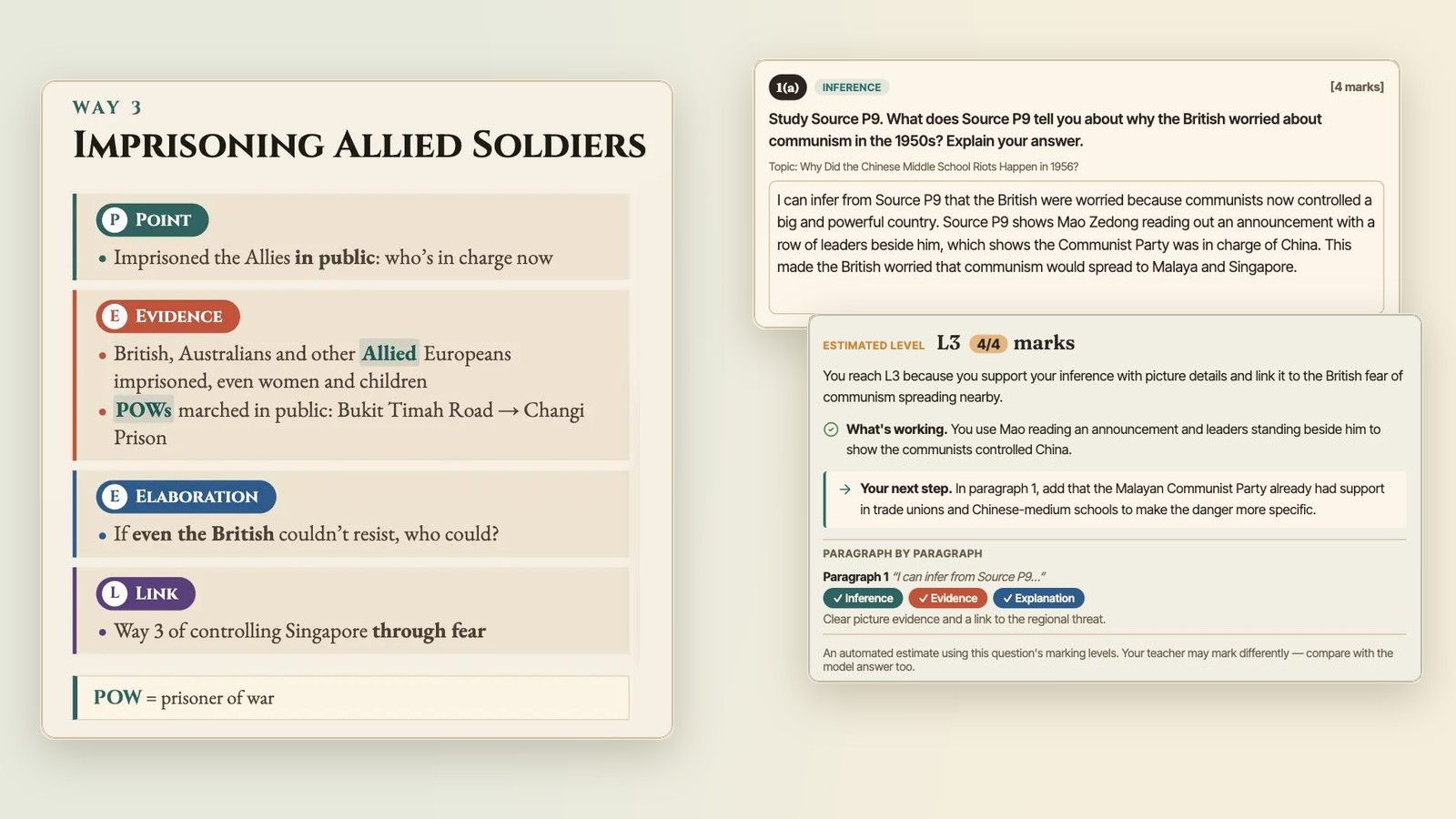
PEEL stands for Point, Evidence, Elaboration and Link. It gives students a reliable structure, so they spend their energy on thinking rather than on working out what to write next. Each part has its own job, shown here in the same colours as our videos:
- PPoint
- The answer to the question, in one clear sentence. One point per paragraph.
- EEvidence
- Specific facts, dates, names or details from a source that back up the point.
- EElaboration
- Explains how the evidence proves the point. It answers "so what?"
- LLink
- Ties the paragraph back to the question, so it is clear how it answers it.
Here's how it looks in a full paragraph, using a Sec 1 topic:
- PPoint
- One reason was Singapore's strategic location.
- EEvidence
- It sits at the southern tip of the Malay Peninsula, on the sea route between India and China.
- EElaboration
- Ships sailing that route, often waiting for the monsoon winds to change, could stop in Singapore to trade and restock. Over time, more merchants came because so many ships already called there.
- LLink
- So Singapore's location made it a natural meeting point for traders, which helped it grow into a busy port.
How to help without being a historian
Ask "How do you know?"
Whenever your child makes a claim, about History or anything else, ask for the evidence. It builds exactly the habit SBQs reward.
Practise with everyday sources
Pick an advertisement or a news photo. Who made it? Who is it for? What do they want us to think? It's the same thinking, with no textbook needed.
Read the marking guide together
Many worksheets come with level descriptors. Reading what a top-level answer needs often helps more than another round of revision.
Look for the "so what"
When they read you an answer, ask: "Why does that evidence matter?" If they can say it out loud, they can write it.
Where Our Study Tribe fits
Every Our Study Tribe video lays out its arguments in PEEL. Source-based questions are broken into small, named steps, students can see how an answer is marked before they write, and every written answer gets an indicative level, one strength and a clear next step.