How Did Migrants Build Singapore's Schools?
How Did Migrants Build Singapore's Schools?
Because the British put trade first, they provided too few schools, and most were for boys. These notes explain how migrants filled the gap: a missionary opened one of the earliest girls' schools, wealthy Chinese traders and founded Chinese schools, and Malay, Arab and Indian communities set up their own. By educating more children, migrants served the community and helped Singapore develop beyond a place of trade.
Why Migrants Stepped In
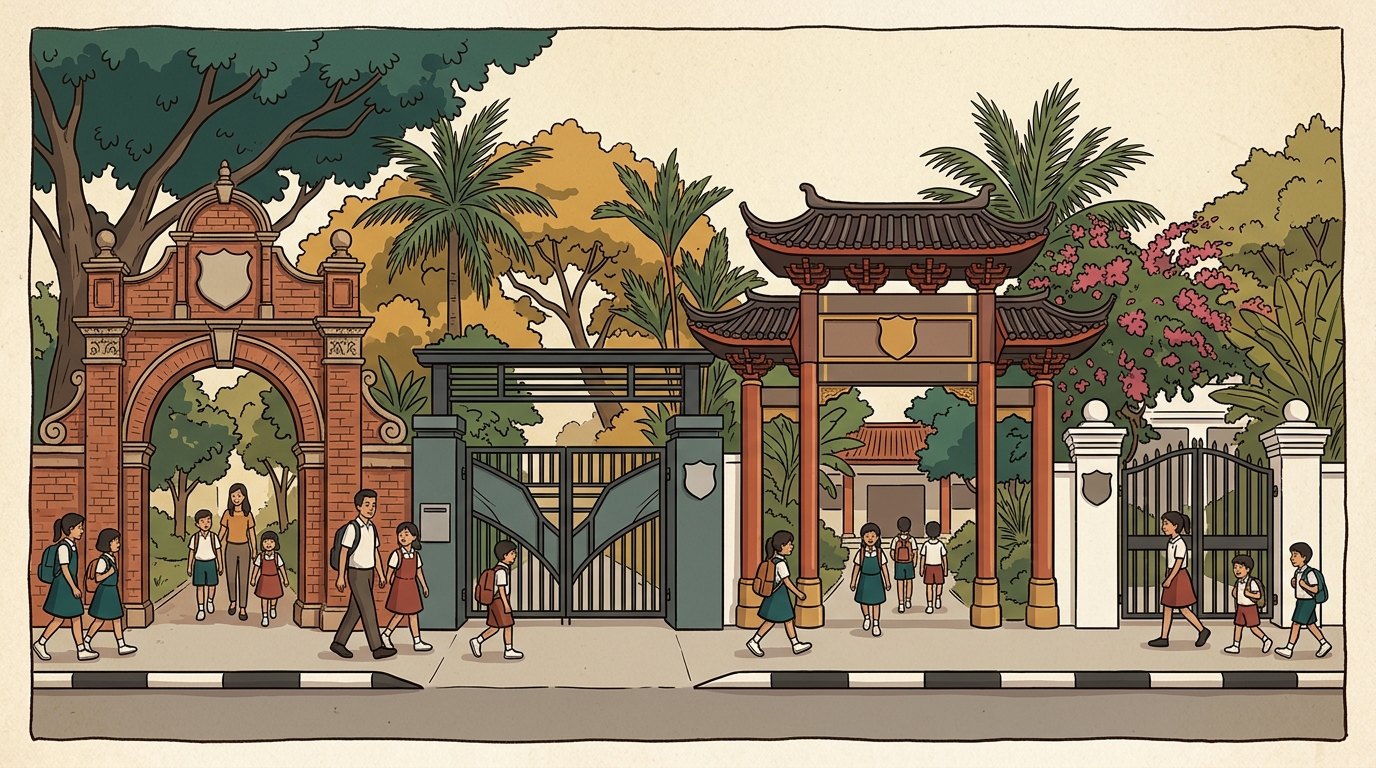
- Trade first: the of ordinary people was not a main focus for the British.
- Few schools: the British mostly ran schools that helped their trade or trained people for government jobs.
- Boys only: before 1900, schools were mostly for boys, apart from a few mission schools for orphaned and homeless girls.
- The result: this gap led people and groups from the migrant communities to set up schools for their own communities.
A School for Girls

- Who: Maria Dyer, an English missionary, started one of the earliest schools for girls in 1842.
- How it began: it was a home for young Chinese girls rescued by the police before they could be sold. She taught them English, the Christian faith and home skills.
- Significance: it opened when educating girls was not thought important, giving girls a chance the British schools did not.
- Today: it is St Margaret's School, Singapore's oldest school for girls.
Chinese Schools
- Tan Kim Seng: opened two Hokkien schools, one near Thian Hock Keng Temple on Telok Ayer Street and one on Amoy Street.
- Gan Eng Seng: started the Anglo-Chinese Free School in 1885, the only school then teaching both Chinese and English. Today it is Gan Eng Seng School.
- What students learnt: lessons in such as Hokkien, Cantonese and Teochew; students recited Chinese literature, wrote letters and used the .
- Clan schools: in 1915 the Singapore Hokkien Huay Kuan opened Chong Hock Girls' School (today Chongfu School).
- Tan Kah Kee: in 1919 he led a group of rich businessmen in starting the Chinese High School (today Hwa Chong Institution), the first Chinese secondary school for boys.
Malay, Arab and Indian Schools
- Malay schools: in the early 1900s, wealthy individuals built Malay schools too.
- A madrasah: the Alsagoff Arab School was founded in 1912 with the help of Syed Mohamed bin Ahmed Alsagoff. It taught Arabic and Islamic knowledge, plus English and Malay.
- Tamil and English: the Ramakrishna Mission set up schools teaching in Tamil and English.
Where Your School Began
- Other early schools: various individuals and groups set up Raffles Institution (1823), St Joseph's Institution (1852) and the Convent of the Holy Infant Jesus (1854).
- Later founding: Raffles Girls' School began in 1879 and Anglo-Chinese School in 1886.
- Museums today: some old school buildings are now museums, such as the Peranakan Museum (once Tao Nan School) and the Singapore Art Museum (once St Joseph's Institution).
How Did Migrants Build Singapore's Schools?
Role: Providing Education
- PPointOne way the people served the community was by providing education where the British provided too little.
- EEvidenceMaria Dyer started a school for girls in 1842 (today St Margaret's School). Gan Eng Seng started the Anglo-Chinese Free School in 1885. The Singapore Hokkien Huay Kuan opened Chong Hock Girls' School in 1915, and Tan Kah Kee led the founding of the Chinese High School in 1919. The Alsagoff Arab School (1912) and Ramakrishna Mission schools taught in Arabic, Malay, Tamil and English.
- EElaborationBecause the British ran few schools and mostly for boys, these migrant-run schools let many more children, including girls and children of every community, learn to read, write and gain skills such as English, which made Singapore a place where families could build a future, not just earn money.
- LLinkHence, migrants helped Singapore develop by educating its people, and they filled the gap in healthcare in the same spirit of self-help.
In One Sentence
- Because the British put trade first and provided few schools, migrants such as Maria Dyer, Gan Eng Seng and Tan Kah Kee built schools for girls and for every community, so many more children could be educated.
Think About It
- Why do you think education for girls was seen as unimportant in the 1800s? What changed when Maria Dyer opened her school?
- Most schools taught in one community's language. What might be good about that, and what might be a problem for a mixed city like Singapore?
- Why would a wealthy trader spend his own money on a school when he could keep it for his business?