How Did the Rendel Constitution Change Politics in 1955?
How Did the Rendel Constitution Change Politics in 1955?
The unrest of the early 1950s exposed the inadequacy of the old system of government, so the British changed course. These notes explain why they did so, how the Rendel of 1955 transformed politics through , automatic voter registration and the rise of anti-colonial parties, and why the 1955 election result shocked the British.
Why the British Changed Course
- The old system failing: the unrest of the early 1950s showed that discontent and anti-British feeling were widespread.
- Building loyalty: the British hoped to make people proud to belong to Singapore; it was made a city on 22 September 1951.
- Relaxed controls: as the Emergency in Malaya stabilised, the British eased anti-communist restrictions in 1953, releasing detainees and allowing new parties and unions, such as the Singapore Factory and Shop Workers' Union (SFSWU) led by Lim Chin Siong, to emerge.
- The Rendel Commission: in July 1953 the British appointed Sir George Rendel to find ways to give locals a bigger role in government.
How Did the Rendel Constitution Change Politics in 1955?
Change 1: Limited Self-Government
- PPointThe Rendel Constitution transferred some, but not all, power to locals by introducing limited self-government.
- EEvidenceFrom 1955, a Council of Ministers comprised a local , five other local ministers and three British ministers. Local ministers controlled education, health, housing, and trade and industry, while British ministers retained law, finance, foreign affairs, defence and internal security.
- EElaborationFor the first time, elected locals ran areas that directly shaped daily life, yet by retaining the key powers of security, finance and defence the British ensured that real control remained in their hands.
- LLinkHence, the Rendel Constitution was a limited but important step towards self-government.
Change 2: Automatic Registration
- PPointAutomatic registration greatly increased political participation in the 1955 election.
- EEvidenceEligible voters no longer had to register themselves. About 160,000 people voted, slightly over half of those eligible, and 79 candidates contested 25 seats, about five times as many candidates as in 1948.
- EElaborationRemoving the need to sign up eliminated a barrier that had kept turnout low in 1948 and 1951, while the bigger share of power at stake gave people a real reason to take part.
- LLinkThus, the 1955 election gave far more people a say in how Singapore was governed.
Change 3: New Anti-Colonial Parties
- PPointThe Rendel Constitution encouraged new anti-colonial parties that convinced voters British rule could be ended.
- EEvidenceThe , founded in July 1954 and led by David Marshall, and the , founded in November 1954 by people including Lee Kuan Yew, both demanded immediate independence. Both were multiracial and campaigned vigorously through house visits, newspapers, pamphlets and rallies.
- EElaborationUnlike the moderate, pro-British SPP, these parties voiced the anti-colonial feeling that had grown since the war, and their energetic campaigns reached ordinary voters across communities.
- LLinkTherefore, the new parties turned anti-colonial sentiment into votes, transforming the 1955 election.
The 1955 Shock
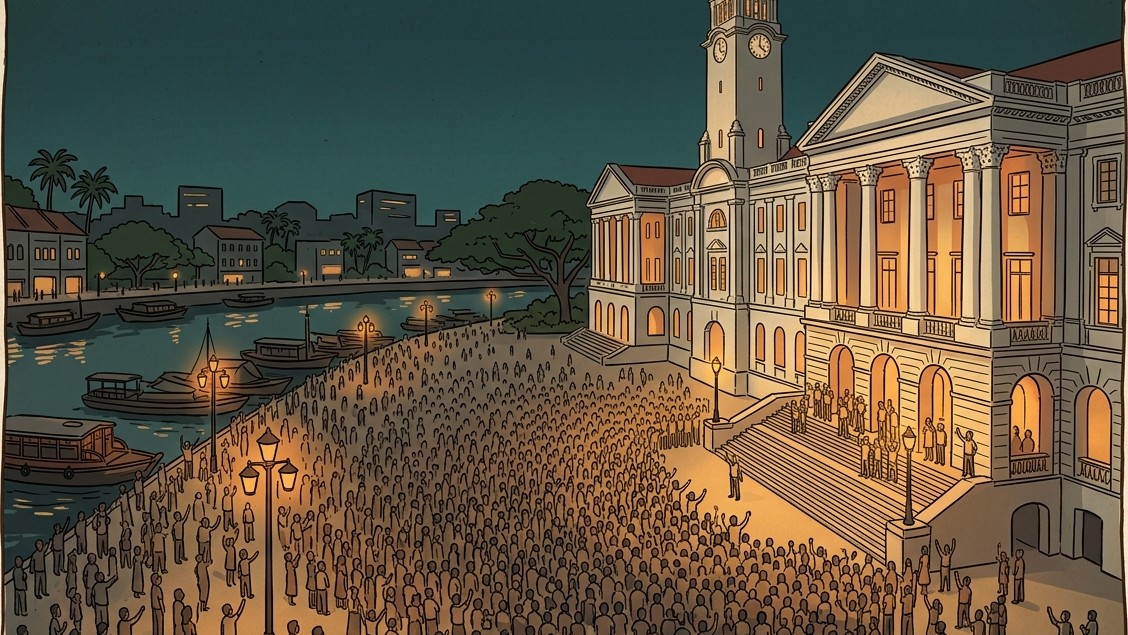
- Election night: over 5,000 people gathered at Empress Place on 2 April 1955 and cheered the results.
- The result: the SPP, which the British expected to win, took only 4 seats, while the Labour Front won 10 of the 25.
- Its significance: the result signalled the strength of anti-colonial sentiment; Marshall said it made people realise they had a voice in how they were to live.
In One Sentence
- The Rendel Constitution of 1955 introduced limited self-government and automatic registration, enabling new anti-colonial parties to win and the Labour Front to form the government.
Think About It
- The British kept law, finance, defence and internal security for themselves. Why do you think they would not hand over those areas yet?
- Automatic registration made voting much easier. Why might making something easier change how many people take part?
- The British expected a party that was friendly to them to win. What does the result tell you about how well they understood the people they ruled?